T-RGB Bike Computer
A bike computer built on the LilyGO T-RGB: a round 480×480 touch display, ESP32-S3 with BLE and WiFi, SD card, and a LiPo charger on board. It reads standard BLE bike sensors, shows turn-by-turn navigation and the climb ahead from your phone, logs every ride to SD card and rates the road surface with its own accelerometer.
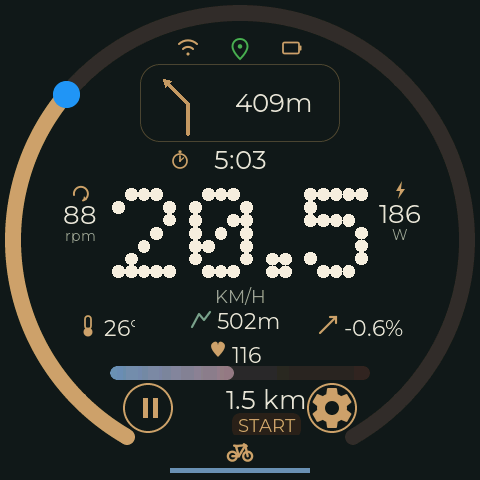
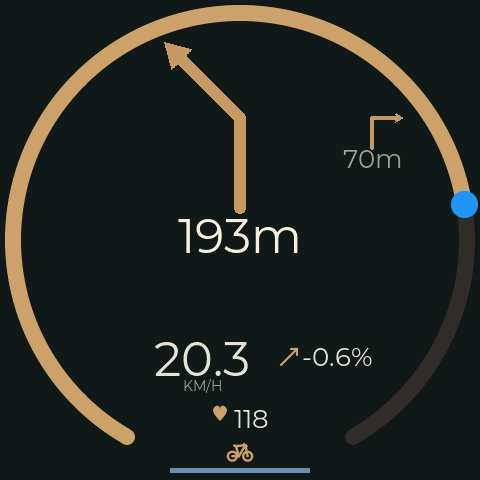
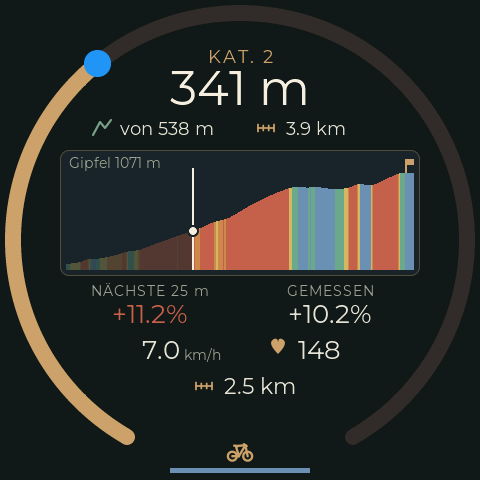
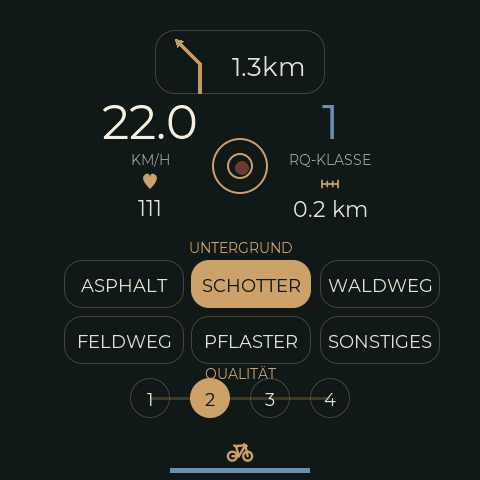
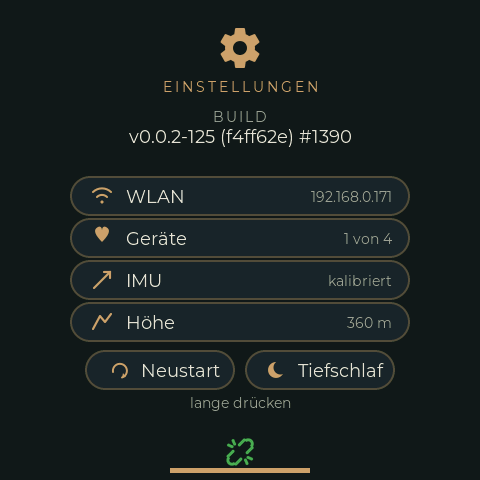
Screenshots from the device, taken during a simulated ride from Villach to Bovec. The texts on the display are German.
Features
Display -- "Rim & Ridge" UI (LVGL 8, designed in EEZ Studio) with five screens: - Main: speed (number and outer ring), cadence, heart rate with zone band, temperature, altitude, gradient, distance (ride / trip / tour / total), ride time or clock, driving state, road-quality line, status icons for WiFi, GPS fix and battery - Navigation: opens by itself before a maneuver and closes after it. Large turn arrow, distance ring, street name, next maneuver, lane guidance, roundabout exits - Climb: elevation profile of the climb ahead, coloured by gradient, with its category; opens by itself at the foot of a rated climb (doc/CLIMB.md) - Road labels: mark surface and quality by hand while riding, as ground truth for the automatic road-quality class - Settings: a hub with one page per group -- WiFi (IP address, on/off, hotspot, network setup with the display keyboard), IMU (calibration and reference ride), height (three presets, GPS, manual height or sea-level pressure, doc/HEIGHT.md), BLE devices (speed, cadence, heart rate, TrailBridge, Forumslader in the FL build: colour = connection, battery level; long press forgets a sensor so another one can pair) -- plus restart, power off, and a mark for simulator builds
Rides and statistics - One button starts a ride, pauses it ("cruise") and ends it; stops and breaks are detected from the speed - Distance, time, average and maximum speed and average cadence per ride, trip, tour and in total; averages with or without stops, breaks and cruise time (doc/design/ride-state-machine.md)
Sensors
- BLE: cycling speed & cadence (CSC), heart rate, battery level of each sensor;
sensors are paired once and locked to their address
- I²C: BME280 (barometric altitude and gradient, temperature), BMI160 accelerometer
- Forumslader hub-dynamo charger via my
BLE gateway (build variant -FL)
Navigation and GPS from the Android companion app
TrailBridge over BLE
(protocol):
- Turn-by-turn instructions from OsmAnd, or from a GPX route that TrailBridge plays
itself -- then with the elevation profile for the climb screen
- The phone's GPS position for the log, and its time for the clock when there is no WiFi
- Tools/gpxenrich turns a plain GPX track into such a route
(turn hints from BRouter)
Road quality from the BMI160 at 400 Hz: roughness class per interval, shock detection (with second peak from the rear wheel), a calibration ride on smooth asphalt, and gradient from the accelerometer as an alternative to the barometer.
Logging - Binary ride log on SD card, one session per boot in dated folders: ride data every 5 s incl. GPS, road quality per interval, every shock, manual road labels, ride states; raw accelerometer captures on demand - Debug log and raw Forumslader log (replayable on the device) - Python tools to convert logs to CSV and GPX, and a service that fetches the sessions when the bike computer shows up in the WiFi, archives them, exports GPX, syncs to Nextcloud and uploads to Komoot
Web interface (when on WiFi) - Download, replay and delete log files; live log with adjustable log levels - Ride statistics with a chart, odometer and wheel calibration - Manage BLE sensors; debug pages for sensors, accelerometer, climbs and crashes - WiFi: saved networks and their priority, hotspot settings (doc/WIFI.md) - Firmware and filesystem update over the air
Serial console with line editing, history and Tab completion (doc/DEBUG.md).
For development: a simulator build with fake sensors
(doc/SIMULATOR.md), screenshots and touch input over HTTP
(Tools/uishot.py), host tests for the pure algorithms (test/, Tools/tests/).
Hardware
- LilyGO T-RGB (the two builds differ in the touch controller variant,
TRGB_ROUND/TRGB_OVAL, and in Forumslader support) - Optional: BME280 and BMI160 on the I²C bus
- LiPo battery
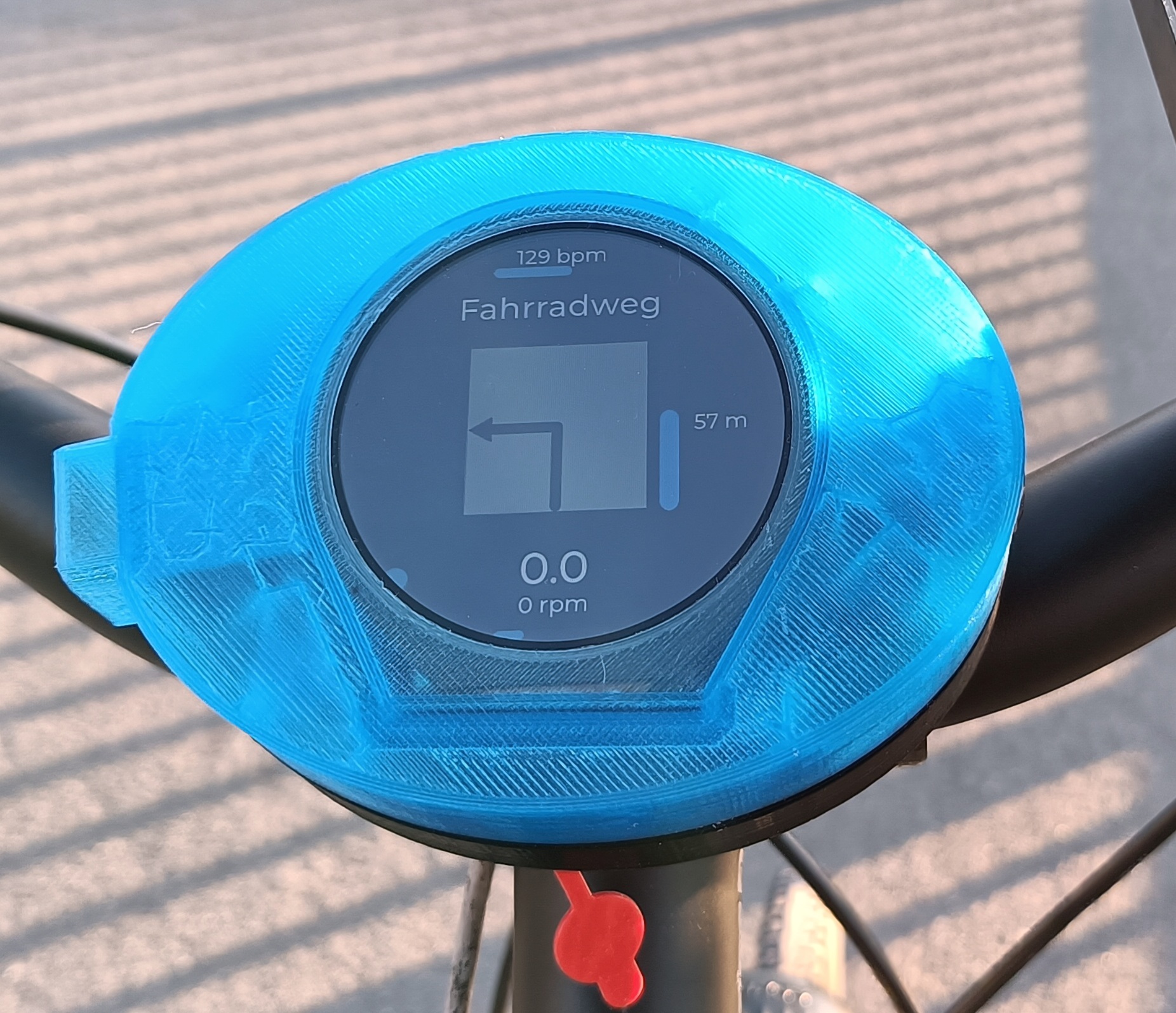
- 3D-printed case and handlebar mounts -- a parametric model for the Canyon CP0007
gravel cockpit is in
cad/
Build
PlatformIO, Arduino framework (pioarduino platform):
pio run -e trgb-esp32-s3 -t upload        # default: BLE + I²C sensors
pio run -e trgb-esp32-s3-FL -t upload     # Forumslader variant
pio run -e trgb-esp32-s3 -t uploadfs      # web interface files (data/site)
trgb-esp32-s3-ota and trgb-esp32-s3-FL-ota are the same builds, uploaded over WiFi
to the device's /update endpoint. Target is TRGB-BC.local; if mDNS doesn't resolve,
pass the IP: pio run -e trgb-esp32-s3-ota -t upload --upload-port 192.168.x.y.
trgb-esp32-s3-sim is the simulator build.
The build applies small patches to two libraries (apply_patches.py), which needs
the patch tool.
Where to go next
- Roadmap: how well each feature is tested, known bugs, planned features
- Climbs and rides and statistics: how the device behaves on the road
- Log format and tools, log service: what happens to the recorded rides
- Debugging, simulator, pitfalls, design system: for working on the firmware
- TrailBridge: the Android companion app and its BLE protocol
Source code: github.com/euphi/TRGB-BikeComputer. Contributions are welcome, see the roadmap for where help is wanted.